AI for Therapy Notes: What Helps and What to Avoid
AI tools promise to cut documentation time dramatically, and for some tasks they genuinely do. But “AI can write my notes” and “AI can safely write my notes” are two very different claims — and the gap between them is where compliance problems start.
The Core Rule: Never Feed PHI Into a Non-Compliant Tool
Most free or general-purpose AI chat tools are not covered by a Business Associate Agreement (BAA), which means typing in a patient’s name, diagnosis, or session details — even to “just save time” — can violate HIPAA. This applies even if the tool is reputable for other uses. The compliance status concerns the specific product and its BAA, not the company’s overall reputation.
Before using any AI tool for documentation, check:
- Does your organization have a signed BAA with that specific product?
- Is the tool approved by your compliance or IT department?
- Does the tool’s privacy policy explicitly address healthcare data?
If the answer to any of these is no, don’t paste in real patient information — not even “just this once.”
Where It’s Risky
- Pasting a full session transcript into a general AI tool for summarization
- Using AI dictation apps that store or transmit audio without a BAA
- Auto-generating notes from patient conversations recorded on a personal device
- Any workflow where identifiable patient information leaves your organization’s approved systems
A Safer Middle Ground: Template + Fill
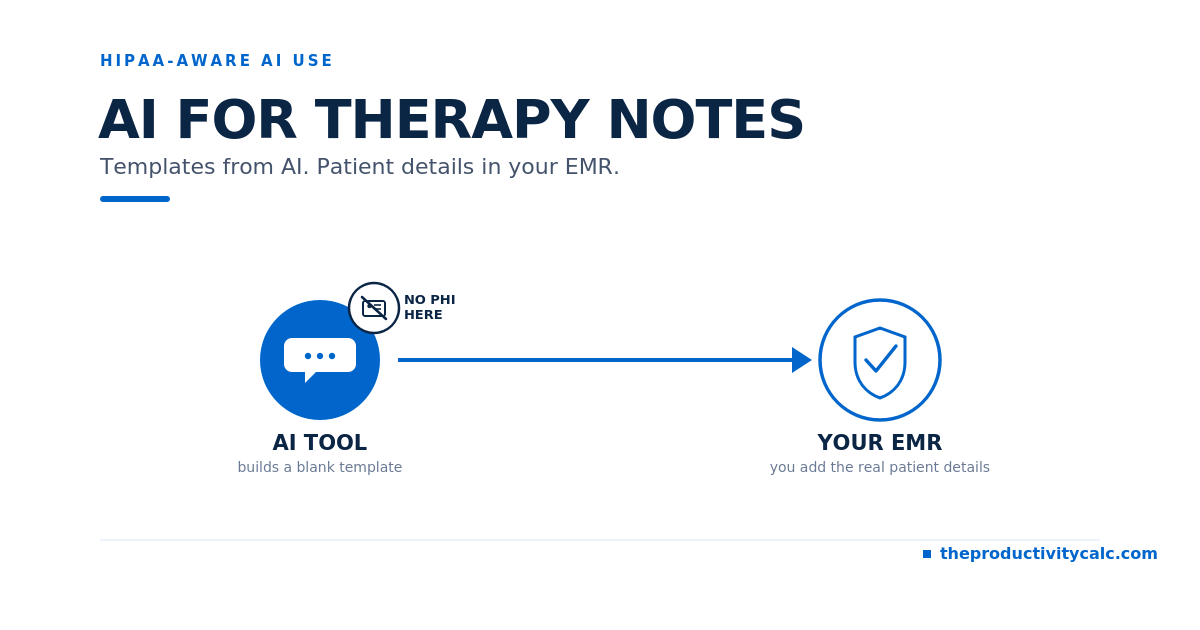
Rather than asking AI to write a note from patient details, use it to build a reusable, PHI-free template once. Then fill in the specifics yourself inside your compliant EMR. This captures most of the time savings — faster structure, less blank-page hesitation — without ever exposing real patient data to a tool that a BAA doesn’t cover.
This pairs well with the transition-routine approach of templating your next note before the session starts, discussed in our guide on between-session transitions.