Concurrent Documentation, Done Ethically
Concurrent documentation — writing notes during a session rather than entirely after it. It is one of the most effective time-savers in clinical practice. Also one of the easiest to do in a way that feels rushed, distracted, or disconnected from the patient. The difference is entirely in how it’s structured.
Why Concurrent Documentation Gets a Bad Reputation
Done poorly, it looks like typing while a patient talks, half-listening, note-taking that competes with actual care. Done well, it’s the opposite: a structured moment, clearly communicated, that doesn’t interrupt the therapeutic relationship.
The problem usually isn’t the practice itself — it’s the absence of a clear boundary around when and how it happens.
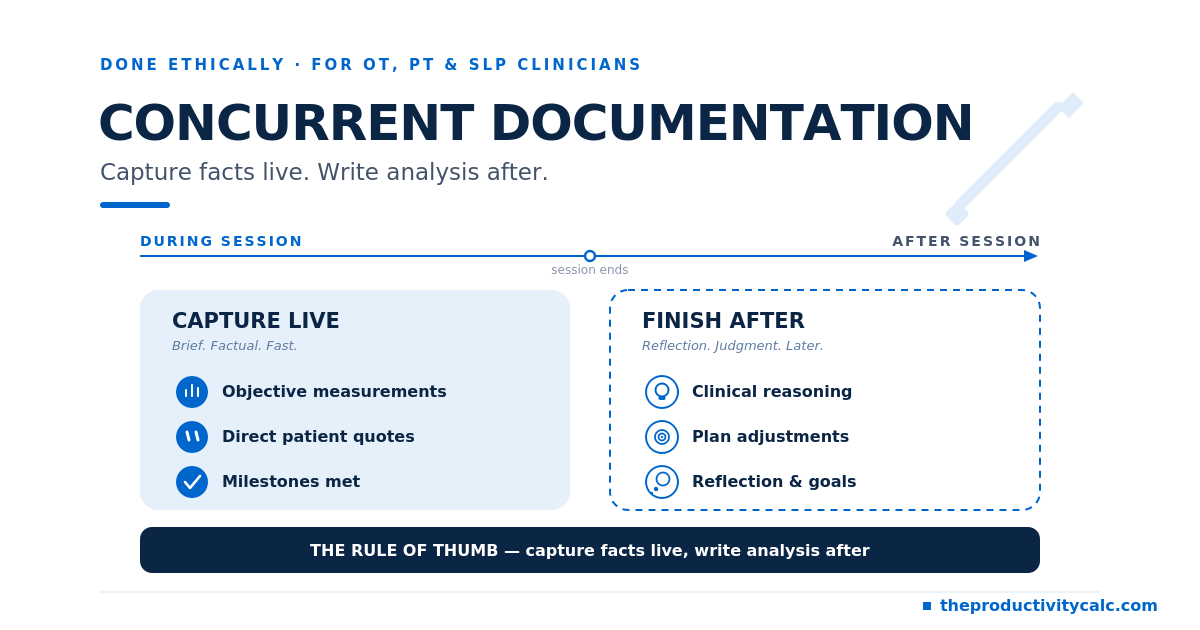
What to Capture Live vs. What to Finish After
Capture live (brief, structured):
- Objective measurements (reps, distance, resistance, scores)
- Direct quotes relevant to functional status
- Specific milestones met or not met during the session
Finish after the session:
- Clinical reasoning and interpretation
- Plan adjustments and goal-setting narrative
- Anything requiring reflection rather than observation
The rule of thumb: capture facts live, write analysis after. This keeps the live portion fast and factual rather than turning into full narrative writing in front of the patient.
Where This Fits Into Your Day
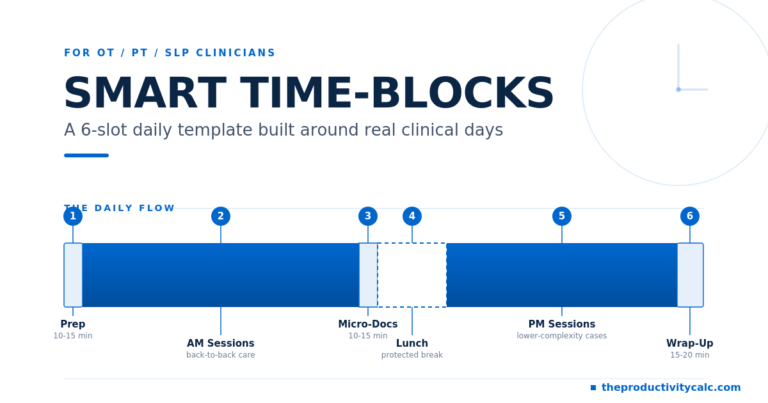
Concurrent documentation done well is what makes a good micro-break routine and session transitions actually work — both rely on notes not being fully blank going into the transition window.
Staying Within Compliance and Billing Rules
Check your setting’s official Medicare documentation and timing guidance before adopting concurrent documentation as a routine — some payers have specific rules about what can be captured live versus billed separately.
Checking Whether It’s Actually Saving Time
It’s worth verifying, not assuming. Compare a week of concurrent documentation against a week of fully after-session notes using a time efficiency calculator — for some clinicians and settings, the time saved is significant; for others, the live-capture overhead cancels it out.