Caseload Mix 101: Balancing High-Need and Low-Need Patients
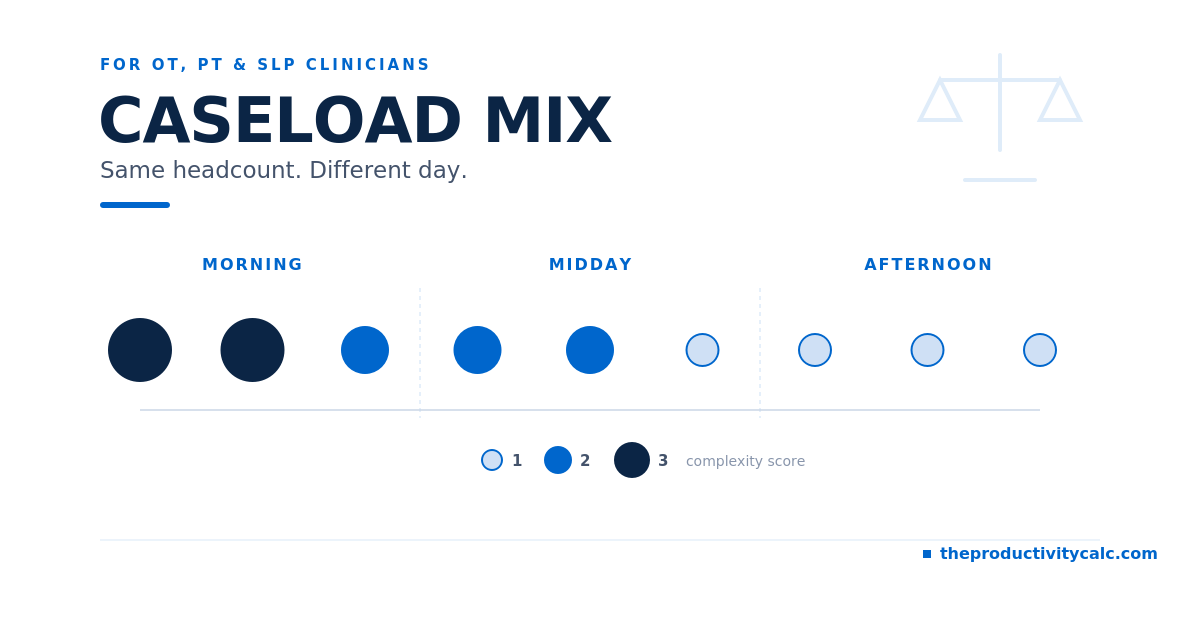
Two therapists can carry the same number of patients per day and have completely different experiences — one drained by 2 p.m., the other steady through closing. The difference usually isn’t caseload size. It’s caseload mix. Let us into Caseload Mix balance.
Why Patient Count Alone Is a Misleading Number
A schedule of eight low-complexity patients and a schedule of eight high-complexity patients look identical on paper. In practice, the second day takes more documentation time, more cognitive load, and more physical effort — even though the productivity percentage might come out the same.
This is why relying only on a headcount, or even a raw productivity percentage calculator reading, can miss the real story of how sustainable a day actually is.
A Simple Complexity Score
Rate each patient on your schedule from 1 (low complexity) to 3 (high complexity) based on factors like:
- Documentation length typically required
- Physical or cognitive demand of the session
- Likelihood of running over scheduled time
- Emotional intensity (common in certain SLP and mental-health-adjacent cases)
Add the scores for your day. A day with a total complexity score clustered at the high end. Even with a “normal” patient count — is a day that needs more built-in recovery time, not just more hours.
Designing a Balanced Day
- Morning (fresh energy): Complex cases first
- Midday: Mixed complexity
- Afternoon (fatigue window): Lean toward lower-complexity cases
This isn’t a rigid formula — it’s a starting point. The goal is to avoid stacking your highest-complexity cases into the hours when you’re already running on fumes.
Where This Intersects With Your Numbers
If your billable productivity target assumes a flat rate per session regardless of complexity, a high-complexity day can push you into overtime documentation even while hitting your percentage target. Check your discipline’s official caseload and workload guidance for a formal reference point. Cross-checking with a labor productivity calculator and a caseload calculator side by side gives a fuller picture than either number alone.