How to Calculate Therapy Productivity | Full Guide
If you’ve ever finished a full day of patients and still felt behind on your productivity number, you’re not imagining it. Productivity in a clinical setting isn’t just “how hard did I work”. It’s a specific formula, and most therapists were never actually taught how to calculate it.
Here’s the good news: once you understand the formula, the mental math gets a lot easier. This guide walks through exactly how productivity is calculated in OT, PT, and SLP settings. What actually counts as billable time, and how to stop doing this math in your head between patients. (If you’ve ever mixed up productivity with billable time itself, our breakdown of Productivity vs Billable Time untangles the two.)
The Basic Productivity Formula
Billable minutes ÷ Total minutes worked × 100 = Productivity percentage
Let’s walk through a real example:
You clock in at 8:00 AM. You take a 30-minute unpaid lunch break. You clock out at 4:30 PM. That’s 480 total minutes at work, minus your 60-minute lunch, so really 420 minutes worked (some facilities count the full 8 hours instead — check your facility’s specific policy). Of those minutes, you billed 360 minutes of direct patient care. 360 ÷ 420 × 100 = 85.7% productivity.
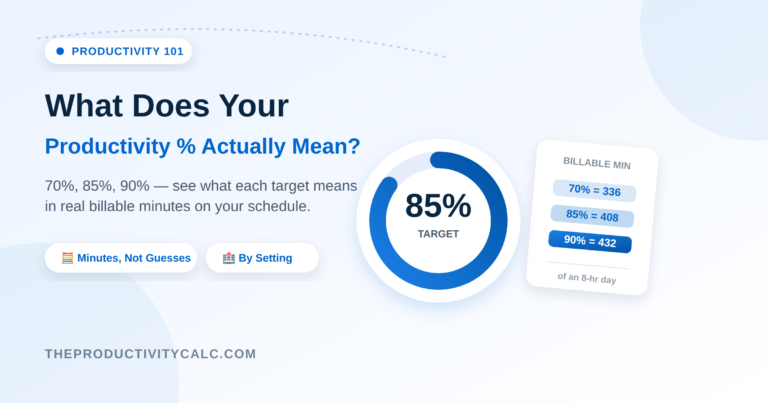
(For a deeper look at what that percentage is really telling you, see What Does Your Productivity Percentage Actually Mean?)
What Counts as Billable Time?
This is where things get murky, and it varies by facility. Generally, billable time includes: direct one-on-one treatment time, group or concurrent therapy sessions (with adjusted crediting — more on that below), and certain re-assessment time.
That last category is exactly why productivity feels like a moving target. Documentation alone can eat 20-30% of a therapist’s day, and it’s rarely factored into the “target” facilities set — which is part of why 89% of therapists surveyed in a 2022 AJOT study said high productivity requirements negatively affected patient care. Productivity math and quality care aren’t automatically at odds, but the math doesn’t account for that tension on its own. If you want to see how much of your own week is disappearing into notes, our Documentation Time Calculator breaks that down by week and by year.
Concurrent and Group Therapy: The Part Nobody Explains Well
Billable minutes don’t scale 1-to-1 here. Individual therapy bills minute-for-minute. Concurrent therapy (2 patients, different plans) splits minutes between them. Group therapy splits too, often by a fixed ratio rather than a straight divide.
Get this wrong, and it costs you either way — undercounting hurts your number for nothing, overcounting risks a compliance issue. Our Concurrent Therapy Calculator handles the crediting automatically. If you’re also charting mid-session, Concurrent Documentation, Done Ethically covers how to do that right.
The Medicare 8-Minute Rule
If you bill Medicare, you’re working within the 8-minute rule: 8–22 min = 1 unit, 23–37 = 2 units, 38–52 = 3 units, 53–67 = 4 units.
The cutoffs don’t land on clean 15-minute marks, which makes this easy to get wrong when doing quick math between patients. Our 8-Minute Rule Calculator converts minutes to units — or units back to a minute range — instantly.
A Faster Way to Do This Math
Once you’ve done this calculation a few hundred times, it’s not interesting anymore — it’s just something eating your break time. A therapy productivity calculator handles all of the above in one step, and works backward too: it tells you your “perfect end time,” the exact clock-out time that still hits your target based on what you’ve billed so far.
The Bigger Picture
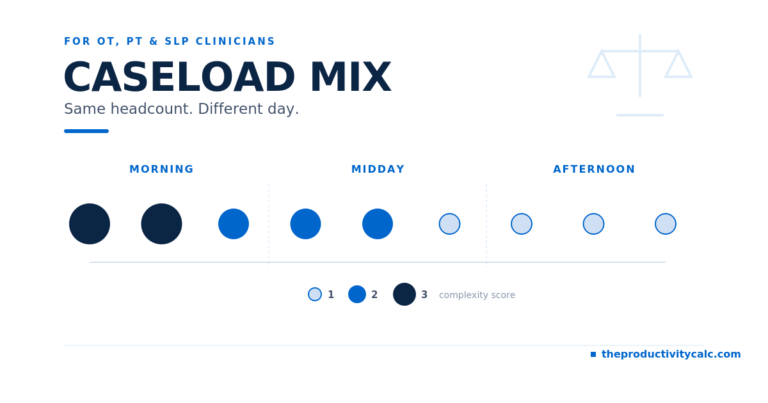
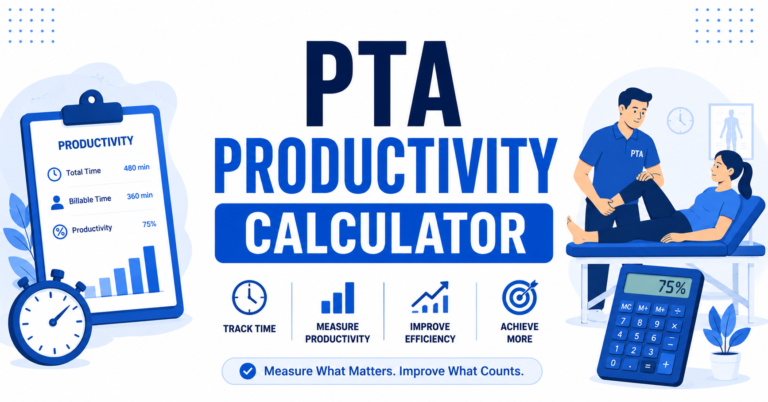
Your productivity percentage is a facility metric, not a measure of how good a therapist you are. Knowing the formula is what lets you push back when a target ignores your documentation load or caseload complexity. PTAs have an extra layer to consider — see the PTA Productivity Calculator guide.
Understanding the calculation is step one. Not doing it by hand every day is step two.