Energy-Based Scheduling: Put Tough Sessions in Your Peak Hours
Most clinical schedules are built around one variable: availability. Whoever’s open at 10 a.m. gets the 10 a.m. slot, regardless of what that session actually demands. Energy-based scheduling for therapists adds a second variable. Matching case difficulty to your actual energy curve, not just your calendar gaps.
Mapping Your Own Energy Curve
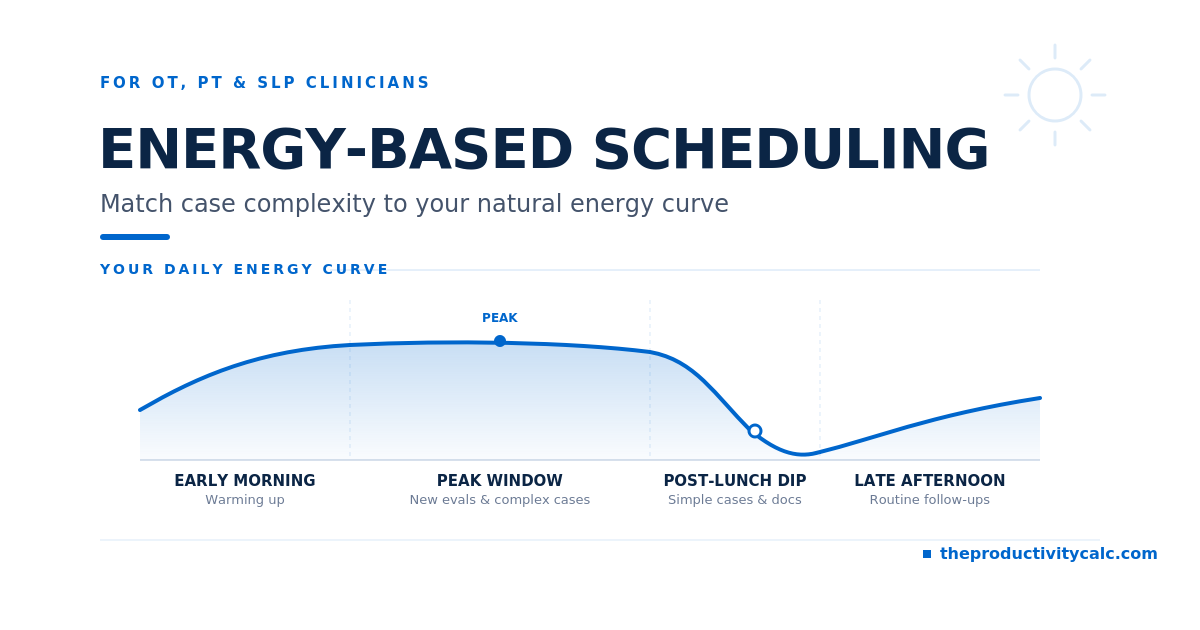
Before you can schedule around energy, you need a rough map of it. For most clinicians working a standard day, the pattern looks something like:
- Early morning: High focus, moderate physical energy (warming up)
- Mid-morning to early afternoon: Peak — sharpest focus and stamina
- Post-lunch: Natural dip (this is real, not a discipline failure)
- Late afternoon: Recovering somewhat, but rarely back to peak
Your specific curve may differ — some people peak earlier, some later. Track it for a week: note your subjective focus level every hour or two, and a pattern usually emerges quickly.
Matching Case Complexity to the Curve
Once you know your peak windows, the scheduling logic is simple:
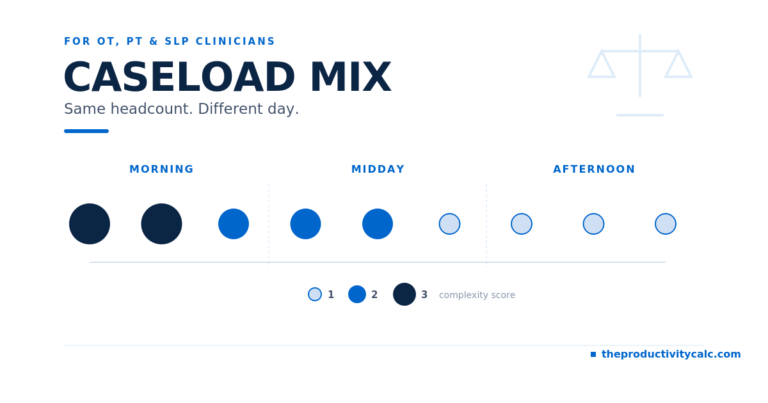
- Peak energy: New evaluations, high-complexity cases, difficult conversations
- Moderate energy: Standard follow-ups, routine treatment
- Low energy (post-lunch dip): Simple, familiar cases; documentation catch-up
This pairs directly with complexity scoring — energy-based scheduling is essentially applying a complexity score to time of day, not just daily totals.
What You Can Actually Control
Not every clinician controls their own scheduling. Where you do have input — flexible slots, self-scheduled follow-ups, or negotiable eval times — energy-based placement is one of the highest-leverage changes available, because it costs nothing and doesn’t require working more hours.
Where you don’t have full control, even flagging your peak and low windows to a scheduler gives them a concrete basis for placement decisions instead of filling gaps arbitrarily.