What Does Your Productivity Percentage Actually Mean?
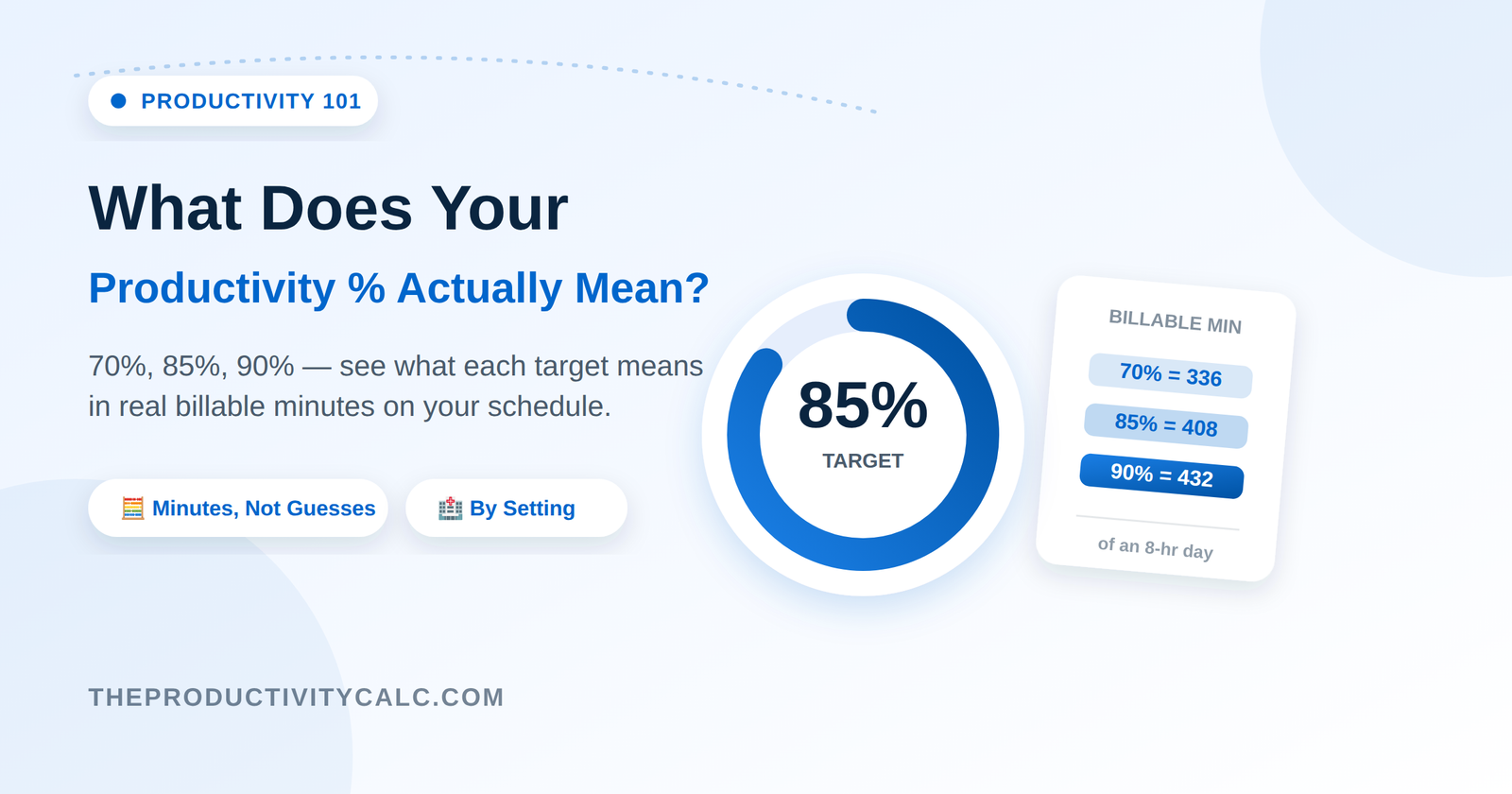
A productivity target is just a percentage until someone converts it into real minutes on your actual schedule. Most explanations stop at the math and skip the part that matters — why your setting lands on one number instead of another, and what that gap in billable minutes really costs you across a shift.
The Core Formula
Every productivity percentage works off the same idea: billable minutes divided by scheduled minutes, times 100. Flip it around, and a target percentage tells you exactly how many billable minutes you need out of your scheduled time.
Formula: Billable minutes required = Scheduled minutes × (Target % ÷ 100
What Each Common Target Means in Real Minutes
Based on a standard 8-hour scheduled day (480 minutes):
| Target | Billable Minutes Required | Non-Billable Minutes Left |
|---|---|---|
| 70% | 336 minutes | 144 minutes |
| 75% | 360 minutes | 120 minutes |
| 85% | 408 minutes | 72 minutes |
| 90% | 432 minutes | 48 minutes |
The gap between these numbers isn’t just arithmetic — it’s the entire margin you have left for documentation, care conferences, and everything else that isn’t direct billing. A jump from 75% to 90% cuts your non-billable window by more than half, from two hours down to 48 minutes.
Calculate Your Own Percentage
Don’t just take the table above at face value — your actual scheduled time probably isn’t a clean 480 minutes. Use the Productivity Percentage Calculator to enter your real numbers and get your exact billable-minute requirement instead of estimating from a general example.
Why the Same Job Gets Different Targets
- 70–75% shows up most in outpatient clinics, where no-shows, late cancellations, and longer evaluation visits eat into the schedule regularly. The lower target exists specifically to absorb that unpredictability.
- 85–90% is standard in skilled nursing facilities, where patients are already on-site, treatment blocks are pre-scheduled, and there’s no drive time cutting into the day.
- Home health sits lowest of all, often 55–65%, because travel time between visits and lengthy OASIS documentation are unavoidable and non-billable. None of these targets are arbitrary; each one reflects how much non-billable friction that setting genuinely has to absorb.
Conclusion
A productivity percentage on its own is just a number until you convert it into minutes against your real schedule — and the target itself only makes sense once you know why your setting landed there in the first place. 70% in an outpatient clinic and 90% in a SNF aren’t the same ask dressed up differently; they’re built around genuinely different amounts of non-billable time each setting has to absorb. Know your setting’s reasoning, then check your own numbers against it rather than assuming one target fits every job