Between-Session Transitions: Save 30 Minutes a Day
The minutes between sessions feel too short to matter — which is exactly why most clinicians waste them. Multiply a wasted 3–4 minutes by eight sessions a day, and you’ve lost half an hour that shows up nowhere except a longer night finishing notes. Let us know how much: a 5-minute between-session transition for therapists.
Where the Time Actually Goes
- Re-reading the last note to remember details before writing the next
- Searching for supplies or equipment that weren’t reset
- Re-orienting mentally after a difficult or emotionally heavy session
- Starting the next chart from a blank screen instead of a template
- None of these are large individually. Together, they’re the difference between finishing on time and staying late
The 5-Minute Transition Routine
- Minute 1 — Reset the room. Equipment away, space ready for the next patient before you sit down to anything else.
- Minute 2 — Template the next note. Open the chart, load your standard template, fill in the objective fields you already know (time, setting, goal area) before the session even starts.
- Minutes 3–4 — Flag the last note. Not full documentation — just the key details that would otherwise be lost by end of day.
- Minute 5 — Reset your state. A breath, a stretch, a sip of water. This is the step most clinicians skip, and it’s the one most linked to afternoon slowdowns.
Why This Stays Compliant
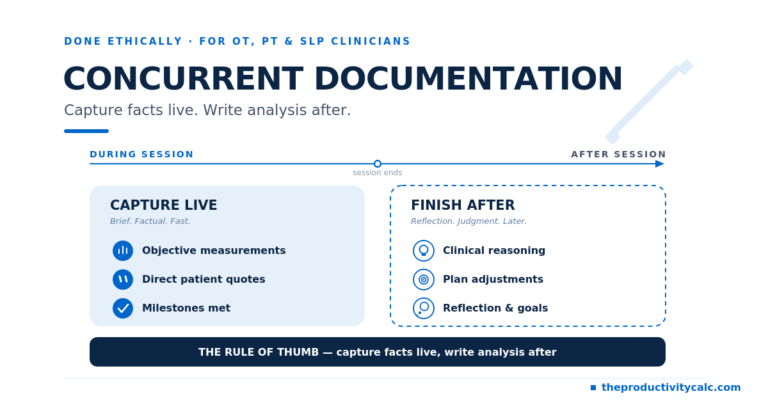
The routine intentionally avoids anything that resembles documenting during patient care unless your setting explicitly allows concurrent documentation — flagging keywords for your own memory is different from writing billable documentation. Review your facility’s documentation timing requirements directly if you’re unsure where that line sits.
What 30 Minutes a Day Actually Means
Over a five-day week, a consistent 30-minute save is 2.5 hours — nearly half a shift’s worth of time returned to you, either as earlier finishes or a lighter end-of-day documentation load. If you want to see this in your own numbers rather than estimate it, log a normal week with a weekly timesheet hours calculator and compare the total documentation time before and after.