The 2-Minute Micro-Break Protocol for OT, PT, and SLP Clinicians
Most therapists don’t get a real break between sessions — they get a hallway, a chart, and about ninety seconds before the next patient is waiting. The problem isn’t that breaks are impossible. It’s that most clinicians never designed one that actually fits in the gap they have. Let us know what the 2-Minute Micro-Break Protocol for OT, PT, and SLP Clinicians means.
Why “No Time for a Break” Is the Wrong Frame
You don’t need fifteen minutes to reset. You need a repeatable two minutes that does three things: clears your head, resets the room, and preps the next note. Treat it like a protocol, not a luxury.
The Protocol: 4 Steps, 2 Minutes
- 0:00–0:30 — Physical reset. Stand, stretch, or step to a window. This isn’t about exercise; it’s about breaking the posture and mental loop from the last session.
- 0:30–1:00 — Room reset. Clear equipment, reset the space for the next patient. Doing this immediately (not “later”) prevents it from piling up.
- 1:00–1:45 — Documentation flag. Don’t write the full note — just jot 2–3 keywords so you don’t lose the details later. This alone saves significant time at the end of the day.
- 1:45–2:00 — Breath and go. A few slow breaths before greeting the next patient resets your tone, not just your task list.
Building It Into a Full Day
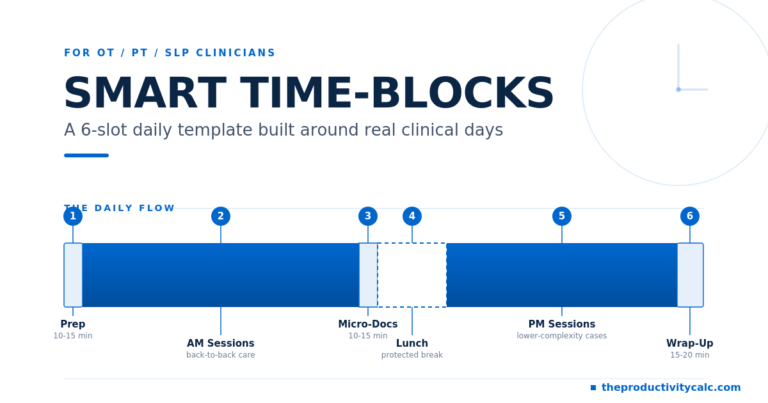
- AM sessions 1–4: 2-min protocol after each
- Lunch: Full break, not a micro-break
- PM sessions 1–4: 2-min protocol after each
- End of day: Convert flags into full notes
If your schedule doesn’t leave even two minutes between sessions, that’s a scheduling problem worth checking with a work time calculator with lunch break — the fix might be in how your day is structured, not in your ability to move faster. Fatigue compounds. A clinician running back-to-back sessions without any reset tends to slow down in the final hours of a shift — which shows up directly in throughput.