SNF Productivity Benchmarks
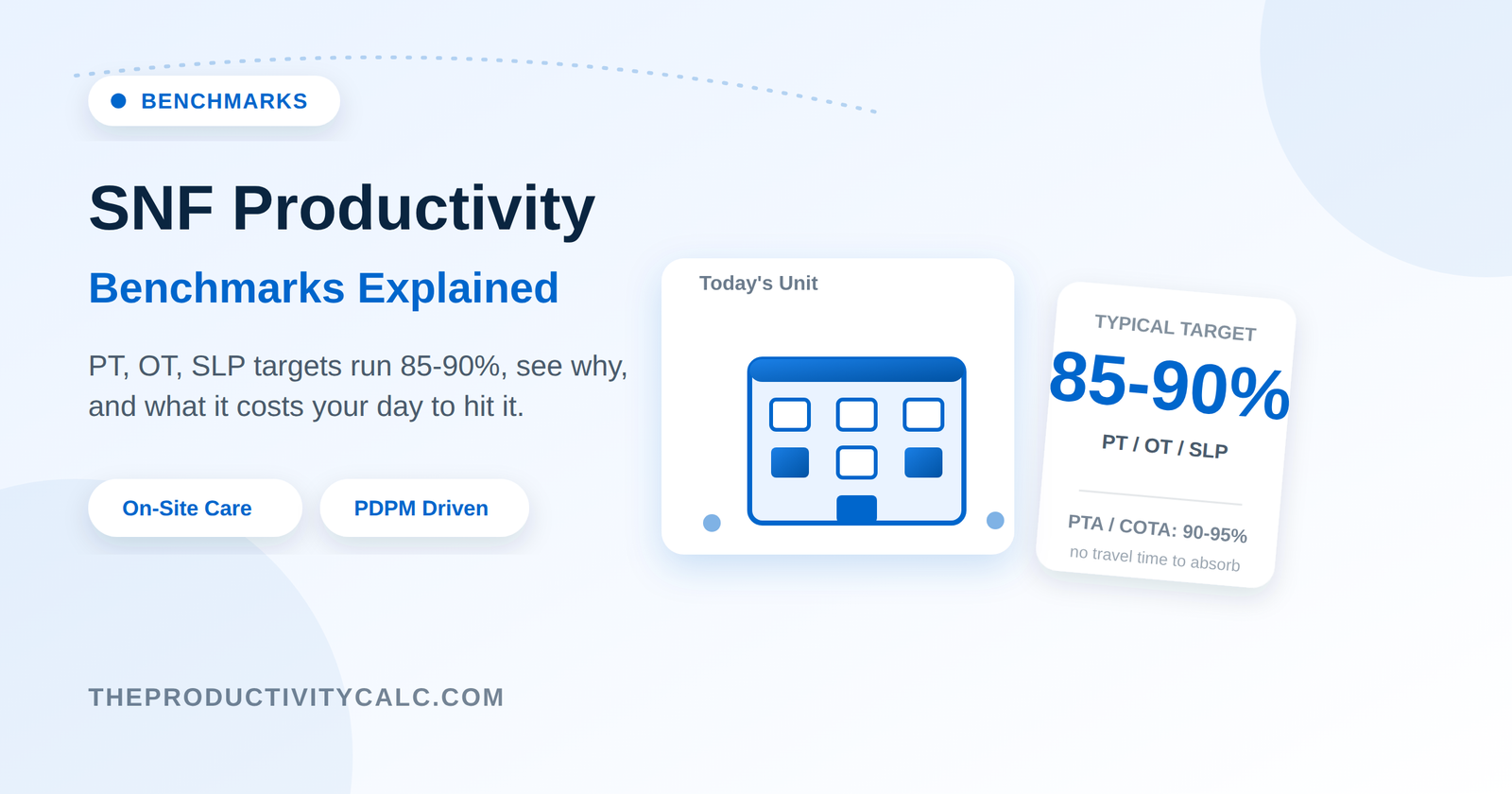
Walk into any skilled nursing facility and ask a PT, OT, or SLP about productivity, and you’ll hear the same number float around: 85–90%. Most articles quote that range and move on. They never explain why the bar sits so high or what it costs you to hit it. Let’s actually break down what SNF Productivity Benchmarks are.
Typical SNF Productivity Benchmarks
- PT / OT: 85%–90%
- PTA / COTA: 90%–95%
- SLP: 85%–90%
SNF targets run higher than outpatient or home health for a simple reason: patients are already on-site. Nobody drives across town to see them. Treatment blocks get scheduled in advance, and facility census drives revenue directly under PDPM, so administrators watch productivity closely. Assistants — PTAs and COTAs — usually get pushed a notch higher than supervising therapists. Their day is almost entirely direct treatment. They don’t carry evaluations, care planning, or discharge paperwork the way a full-license therapist does.
What a 90% Target Actually Means for Your Day
Picture an 8-hour shift — 480 minutes. At 90%, you need 432 billable minutes. That leaves just 48 minutes for documentation, care conferences, and anything else that isn’t direct treatment. Tight? Definitely.
- Now factor in a 30-minute unpaid lunch. Most facilities don’t count it against your productivity minutes, but it still eats into your working window. Run the numbers through the Lunch Break Calculator and watch your real clock-out time push later than the simple math implies.
- Group and concurrent treatment adds another wrinkle. Your billable minutes change depending on whether your facility credits full time to each patient or splits the clock across the group. That’s the exact problem the Concurrent Therapy Calculator solves — enter your patient count and crediting model, and it does the recalculation for you instead of you scribbling math between sessions.
Why SNF Targets Run So High — and Where They Break Down
High productivity expectations assume a clean, predictable day. Patients stay on the unit. Cancellations stay rare. Treatment blocks don’t need chasing. Real shifts rarely cooperate. Call-outs happen. Hospital transfers happen. Unplanned care conferences eat into your schedule without warning.
- If your facility’s target never bends for these disruptions, start tracking your actual numbers for a few weeks instead of trusting the target blindly. The Documentation Time Calculator shows you exactly how much of your week paperwork consumes, separate from treatment time.
One more thing worth remembering: productivity measures billable time against scheduled time. It says nothing about care quality. A 90% day built on rushed notes isn’t a win — it’s a burnout risk waiting to happen. If you can’t hit your number without cutting corners, that’s a staffing conversation, not a personal failure.